
Muscimol and overcoming fear: what the research really shows
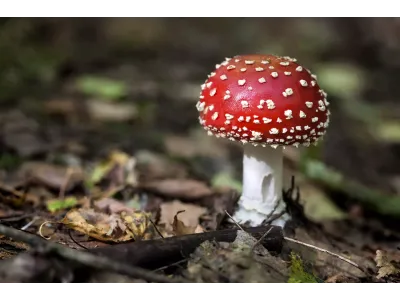
Muscimol is one of the main neuroactive substances in the red fly agaric (Amanita muscaria). It is of particular interest to neurobiologists due to its interaction with GABA-A receptors, an important part of the brain's inhibitory system.
This mechanism has led to claims that muscimol can "remove fear," help with anxiety or even PTSD. The real scientific picture is more interesting, but much more complex. Experiments have indeed shown a connection between the GABAergic system and the extinction of the acquired fear response. However, most of this data has been obtained on laboratory animals.
What is muscimol?
Muscimol is a natural isoxazole compound, best known as a component of Amanita muscaria. In neuropharmacology, it is used as a GABA-A receptor agonist.
GABA, or gamma-aminobutyric acid, is one of the main inhibitory neurotransmitters in the central nervous system. In simple terms, it helps regulate excessive neuronal activity.
That is why GABAergic mechanisms are actively studied in neurobiology. They are associated with sleep, memory, emotional reactions, and many other processes.
However, the pharmacological activity of muscimol does not automatically mean that the red fly agaric itself is an anti-anxiety agent.
What does "fading of fear" mean?
In neurobiology, there is a concept called extinction of conditioned fear . This is not the literal removal of fear from the brain.
Let's imagine that a neutral sound is repeatedly accompanied by an unpleasant event. After a certain time, the very appearance of the sound begins to cause a protective reaction. If the sound is repeated many times in the future without a negative stimulus, the reaction gradually weakens.
This process is called extinction of conditioned fear.
It is of interest to scientists because of the involvement of the prefrontal cortex, amygdala, and other brain structures related to learning, memory, and emotional behavior.
The famous muscimol experiment of 2006
One of the most interesting studies was published by Irit Akirav, Hagit Raizel, and Mouna Maroun in 2006 in the European Journal of Neuroscience.
Scientists worked with Sprague-Dawley rats and examined two brain structures: the infralimbic region of the prefrontal cortex and the basolateral amygdala.
The researchers used a small dose of muscimol, injected directly into specific areas of the brain, and then assessed changes in conditioned fear responses.
This is an important detail. The study did not use capsules, powder, or extract of fly agaric. It was a controlled neurobiological experiment with local microinfusion of a specific substance.
What the results showed
The result depended on where and when the muscimol was injected.
Injecting the substance into the infralimbic prefrontal cortex before extinction training resulted in long-term facilitation of this process. The researchers observed the effect after both short and longer training sessions.
For the basolateral amygdala, the picture was different. Administration of muscimol after a short session promoted extinction of the response, which was recorded after at least 48 hours.
The authors suggested that GABA-A receptors in different brain regions may serve different functions. The prefrontal cortex may be involved in initiating and maintaining extinction, while the amygdala may be involved in consolidating the corresponding memory.
Does this mean that muscimol “removes fear”?
No. This is where popular articles often take too big a step from a laboratory result to a practical recommendation.
The experiment shows the involvement of GABAergic transmission in the mechanisms of extinction of conditioned fear in rats. It does not prove that taking fly agaric treats fear, phobias, panic attacks, or post-traumatic stress disorder in humans.
Moreover, dosages from experiments with pure muscimol cannot be transferred to dried mushrooms. Amanita muscaria contains a complex of active substances, and their concentration in natural raw materials may vary.
Muscimol, the amygdala, and the prefrontal cortex
It is the interaction between these structures that makes the 2006 study so interesting.
The amygdala is involved in the formation and processing of emotionally meaningful associations. The prefrontal cortex is involved in more complex mechanisms of behavioral control, learning, and regulation of emotional responses.
Therefore, scientists are interested not only in the question “does the substance reduce fear?” It is much more important to understand how the brain learns to no longer respond with fear to a stimulus that is no longer dangerous .
Muscimol in such experiments acts primarily as a research tool.
Why this research is important for science
Fear itself is necessary for humans. Without it, we would react much worse to real danger.
The problem arises when a protective response persists after the threat has disappeared. That is why the mechanisms of emotional memory formation and extinction are of interest to neuroscientists.
Studies of GABA-A receptors are helping to understand how this system works at the molecular level, potentially providing the foundation for future therapeutic approaches.
But between a laboratory discovery and a ready-made therapy can lie years of clinical research.
Muscimol and anxiety in humans
Here the evidence base is much weaker than one might think after reading the advertising materials.
Muscimol is known to interact with GABA-A receptors. It is also known that the GABAergic system is important for the regulation of central nervous system activity.
But these two facts are not enough to call muscimol a proven remedy for anxiety.
It is especially incorrect to claim that Amanita muscaria can replace psychotherapy or drug treatment for anxiety disorders, phobias, or PTSD.
Muscimol and fly agaric are not the same thing
This distinction is often overlooked.
Muscimol is a specific chemical compound. Amanita muscaria is a mushroom that contains a whole complex of components, including ibotenic acid.
If in a laboratory study, scientists inject a controlled amount of purified muscimol directly into a specific brain structure, the result of such an experiment cannot be automatically transferred to the use of mushroom raw materials.
This is one of the most important details for properly understanding fly agaric research.
Safety of Amanita muscaria
Interest in the pharmacology of muscimol does not negate the toxicological risks of red fly agaric.
Amanita muscaria contains neuroactive components and can cause adverse reactions. Symptoms described in poisoning include digestive and central nervous system disorders, drowsiness, agitation, disorientation, and in severe cases, serious neurological complications are possible.
Therefore, the concept of "natural" should not be equated with the concept of "safe."
What we really know about muscimol and fear
| Assertion | What is known |
|---|---|
| Muscimol interacts with GABA-A receptors | Yes, this is an established pharmacological mechanism. |
| The GABAergic system is involved in fear extinction | Yes, this is confirmed by experimental studies |
| Muscimol affected the extinction of conditioned fear in rats | Yes, this effect was demonstrated in a 2006 study. |
| Muscimol treats anxiety in humans | There is insufficient clinical evidence. |
| Amanita muscaria treats phobias or PTSD | Not proven |
| Safe dosage of dried fly agaric established for treating fear | No |
Why interest in muscimol continues
Muscimol is interesting not because science has already found a natural remedy for fear. On the contrary, it helps researchers ask new questions.
How does the brain remember danger? Why do some associations fade quickly while others persist for years? What role do the prefrontal cortex, amygdala, and GABA receptors play?
It is these kinds of questions that gradually shape our understanding of emotional memory.
For Effectplants This topic is interesting primarily from the perspective of modern research on natural compounds. We advise separating scientific facts from loud promises and not considering experimental results as ready-made medical recommendations.
Frequently asked questions about muscimol
What is muscimol?
It is a natural neuroactive compound found, in particular, in the red fly agaric Amanita muscaria. In pharmacology, it is known as a GABA-A receptor agonist.
Has muscimol been studied in the context of fear?
Yes. In particular, a 2006 study in rats showed that local microinfusion of muscimol into certain areas of the brain under certain conditions contributed to the extinction of the acquired fear response.
Does this mean that muscimol treats fear in humans?
No. Animal experimental results are not evidence of clinical efficacy in humans.
Can fly agaric be used for anxiety or PTSD?
There is insufficient clinical evidence of the effectiveness and safety of such use. If you have an anxiety disorder, panic attacks, phobias, or PTSD, you should consult a qualified medical professional.
Are muscimol and fly agaric the same?
No. Muscimol is a separate chemical. Red fly agaric is a natural raw material with a complex and variable set of components.
The Effectplants material is for informational purposes only. It does not constitute medical advice and is not intended to diagnose, prevent, or treat disease.




Write a comment